
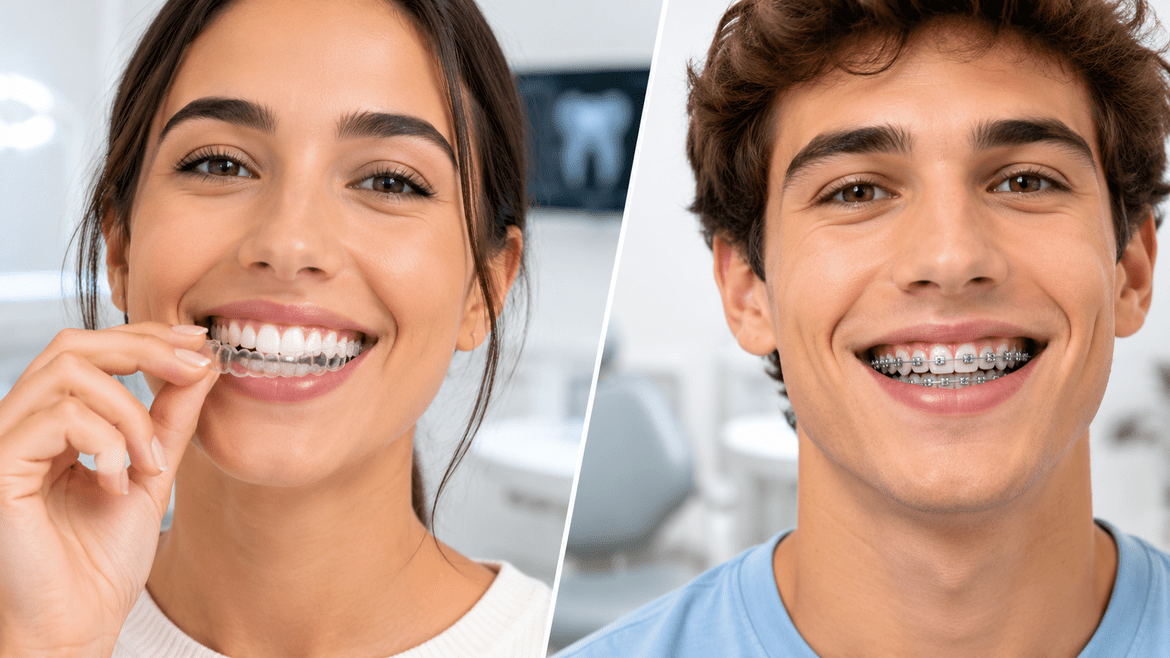
If you’re comparing Invisalign vs braces in Markham, you’re probably wondering which treatment is the better choice for your smile.
Both work. Both will get you a straighter smile and a bite that actually lines up. But they go about it in completely different ways, and the better one really does change from person to person. It depends on your teeth, sure. Honestly, though, it depends just as much on how you live and what you can spend.
Here’s the head-to-head, cost and comfort and timeline and all, so you walk into your consultation knowing what to ask instead of just nodding along.
The Short Answer
Nobody wins outright. Here it is in a sentence: braces are the workhorse that handles tricky cases and never needs reminding, while Invisalign is the low-profile option that only pays off if you’re disciplined about wearing it.
For most people, either one gets the job done. Which means the real decision usually isn’t about your teeth at all. It’s about your life and your budget.
Want a straight answer for your own mouth?
That’s what a consultation is for. Our team at HTL Dental here in Markham does both through our Invisalign & Braces service, and we’ll tell you which one actually makes sense for you. Even if it’s the cheaper one.
What’s Actually Different Between Them?
Essentially, they’re doing the same thing: nudging your teeth into place with steady pressure, a little at a time, over months. What changes is the hardware on your teeth, or the lack of it.
Braces
Metal brackets glued to each tooth, a wire threaded across them, and regular visits where someone tightens or swaps that wire. The tension does the slow work of pulling everything into line. The upside is dead simple. They’re stuck on, so they’re always working. You don’t have to do a thing.
And no, they’re not the mouthful of metal you’re picturing from grade school. They’ve slimmed down a lot. Want them even more discreet? Clear ceramic brackets exist.
Invisalign
No brackets at all. You get a set of clear plastic trays molded to your teeth, and you swap to the next one every week or two as things inch along. Pop them out to eat. Pop them out to brush. Snap them back in.
The one catch is a big one. They need to be worn 20–22 hours per day for effective treatment. Basically everything except meals. Wearing them for fewer hours can delay your treatment.
Braces vs Invisalign Pros and Cons
Every option costs you something, and that’s really the point of a braces vs Invisalign pros and cons list. You want to see what you give up, not just what you get. Start with braces. The benefits of braces vs Invisalign are mostly about muscle and not having to think:
Braces
- They power through the hard stuff. Bad crowding, wide gaps, a bite that’s genuinely off. Aligners tap out where braces keep going.
- Nothing to lose, nothing to forget. On the job 24/7, whether you’re paying attention or not.
- Usually the smarter pick for kids and teens, who are, let’s be honest, not going to babysit a set of trays.
What you put up with:
- People can see them. Even the ceramic ones, up close.
- Popcorn, gum, caramel, off the menu. And cleaning around the wires is a chore.
- Tender teeth for a day or two after every tightening.
Invisalign
Invisalign runs the other way. The good part:
- Barely there. This is the whole reason adults pick it.
- Come out, so you eat whatever and brush like normal.
- Comfier, generally. No wire ends jabbing your cheek.
The catch:
- Discipline is the entire ballgame. Trays left in a napkin at lunch? Progress stops.
- Not built for the gnarliest cases.
- Lose a tray, and you’re looking at a delay, maybe a fee.
Invisalign vs Braces Cost in Markham
Let’s talk about money, because for a lot of people, this is where it’s decided. Around Markham, the Invisalign vs braces cost lands in roughly the same neighborhood, though braces usually start a little lower.
- Metal braces: Somewhere around $3,000 to $7,000, depending on how much your bite needs.
- Invisalign: Closer to $4,000 to $8,000, again down to complexity and how many trays your plan runs.
Treat these figures as estimates, as every treatment plan is different. The real figure hangs on how long you’re in treatment and how tough your case is, and nobody can hand you that number without looking in your mouth first.
Does Insurance Chip In?
Usually some. Plenty of Canadian plans put money toward orthodontics, often with a lifetime cap you can spend on braces or Invisalign, adults included, not just kids. It won’t cover everything. But it takes a real bite out.
We go through your coverage with you at HTL Dental and sort out a payment plan before you’ve committed to anything, so there are no surprises later.
Braces vs Invisalign Timeline
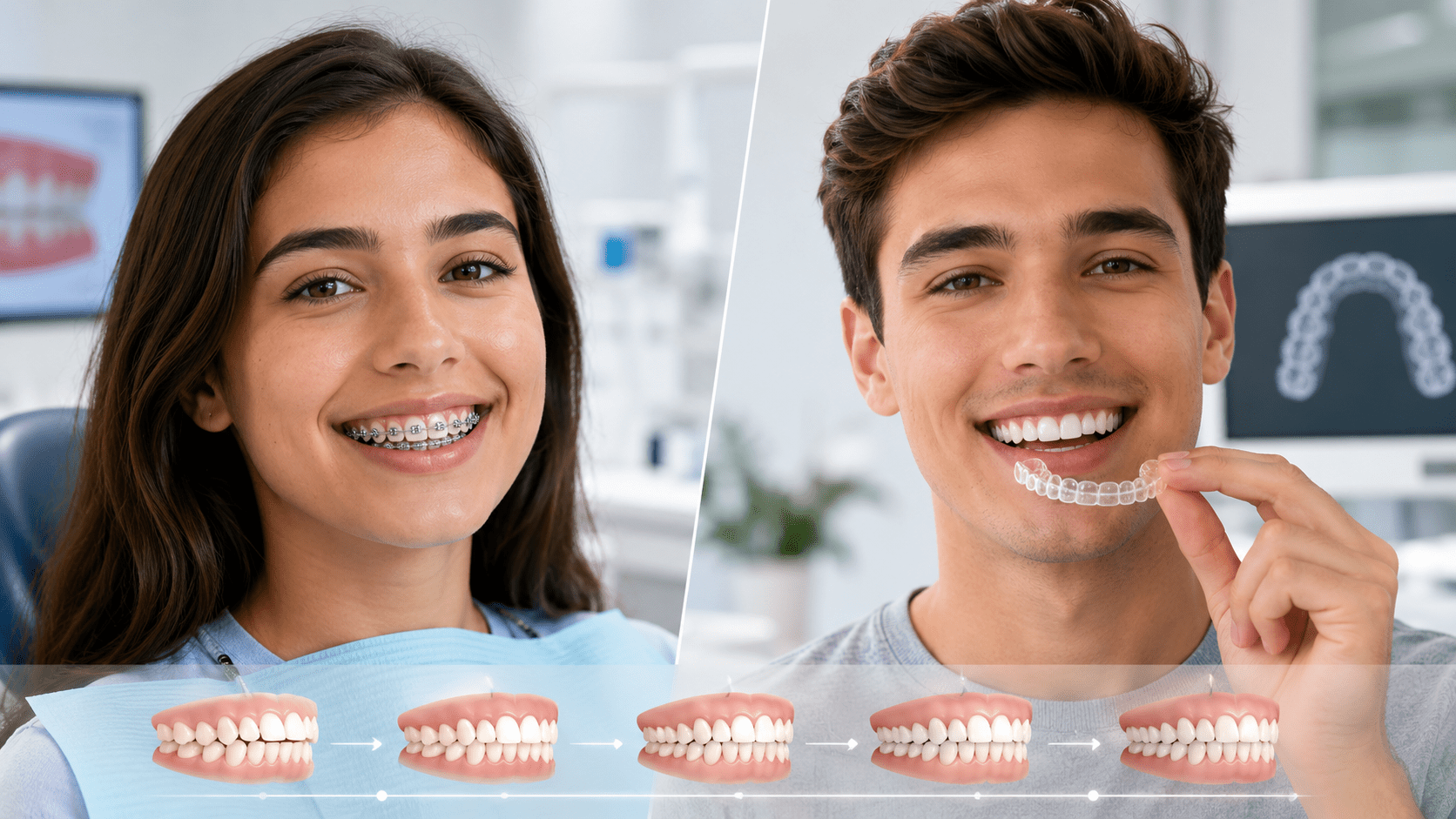
The braces vs Invisalign timeline is tighter than most people guess. Both tend to land between 12 and 24 months for a normal case. Small fixes wrap up faster. Complicated ones drag on. What tips it one way or the other:
- The distance your teeth have to travel. More corrections, more months. True for both.
- How honest are you about your Invisalign wear time? Cut corners and the finish line moves.
- Plain biology. Teeth move at their own speed, and everyone’s is a bit different.
In the really stubborn cases, braces pull ahead because they’re always on and can push harder. On the everyday stuff, Invisalign keeps pace fine, sometimes with fewer trips to the chair.
One Thing People Forget: Retainers
The job isn’t done when the braces come off or you finish your last tray. Teeth want to wander back where they came from. So you’ll wear a retainer afterward, usually just overnight, to lock the result in. Skip it and you can undo a year of work, small habits, big payoff.
So, Which One is Right for You?
Four questions usually settle it.
- What shape is your case in? Mild or moderate crowding, and you’ve got a real choice. A serious bite problem tilts you toward braces.
- Can you stick with it? Invisalign only works for people who keep the trays in. If that’s not you, braces take willpower out of the picture.
- Does it matter if people see it? If metal on your teeth at work or school makes you cringe, aligners fix that on day one.
- What’s the budget? When the lowest sticker price is the priority, braces tend to edge it.
There’s no wrong answer, just the one that fits your life. Teenagers usually land on braces. Working adults lean toward Invisalign. And plenty of folks could flip a coin, which is completely fine.
Final Thoughts
Truth is, you can’t crack Invisalign vs braces in Markham from a blog. Not really. The right move depends on someone actually looking at your teeth, your bite, and what you’re hoping to walk away with.
That’s the part we do. At HTL Dental, our Invisalign & Braces service keeps both options in-house, so our dentists can lay out what each would mean for your smile, your calendar, and your wallet, side by side.
We see families and adults from all over Markham and the GTA, and we work in English, Cantonese, Mandarin, and Korean, so you can have the whole conversation in whatever language feels easiest.
Book a consultation when you’re ready. You’ll get a real recommendation, not a pitch.
FAQs
Does Invisalign treatment require more discipline than braces?
By a mile, yes. Aligners only work while they’re in, and the goal is 20 to 22 hours a day, every day. Pull them for a meal, forget to put them back, and you’ve lost ground. Braces don’t care whether you’re paying attention. They’re glued on and grinding away on their own.
Which option is easier to clean and maintain?
Invisalign, no contest. Trays come out, you brush and floss the way you always have, you rinse the trays, done. Braces are fussier. Food and plaque wedge in around the brackets and wires, and you end up fishing it out with special brushes or a floss threader.
Will Invisalign or braces affect my speech or eating habits?
A little, for a bit. Fresh braces leave your teeth sore for a few days and put hard or sticky foods off limits the whole time. Invisalign might give you a faint lisp the first few days while your tongue figures out the trays, but since they come out to eat, nothing’s off the menu.
How often are follow-up appointments needed during treatment?
Braces mean a visit every four to eight weeks or so, to adjust the wire. Invisalign check-ins tend to be lighter, more like every six to ten weeks, since you’re switching trays yourself at home. Your dentist sets the rhythm based on how things are tracking.
Can I switch from braces to Invisalign during treatment?
Sometimes. If your teeth are far enough along that aligners can carry it home, a switch can be on the table. It hinges on where you are and what your bite still needs, so treat it as a conversation with your dentist rather than a given.
What factors determine whether I’m a good candidate for Invisalign?
Mostly how complex your case is. Invisalign shines on mild to moderate crowding, spacing, and a lot of everyday bite issues. Really severe misalignment may still need braces. And your willingness to wear the trays counts just as much, because even an ideal candidate gets nowhere without the hours. An exam is the only way to know for sure.`